Winter is a lean time for spotting fungi. The visible parts are the fruiting bodies, and in most species these are very vulnerable to frost.
There are, however, some exceptions which can still be seen.
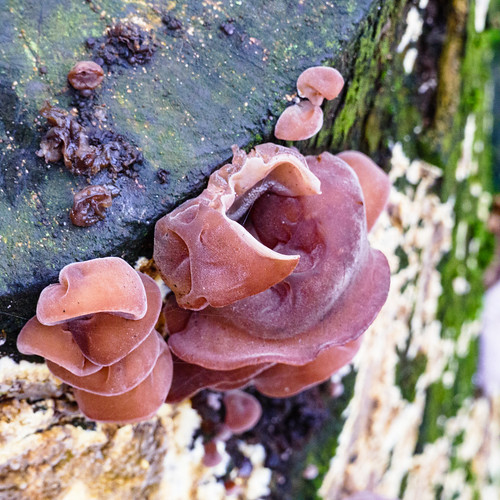
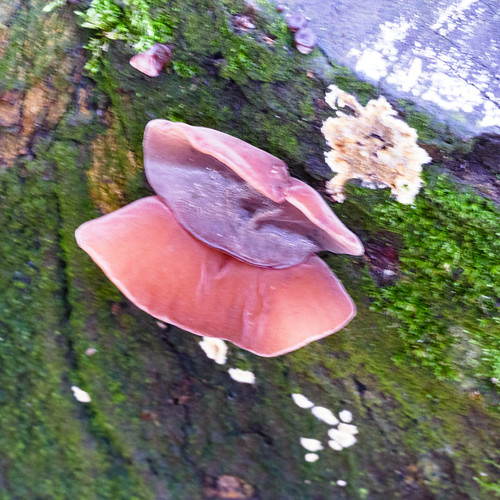
One such is the jelly ear fungus, with gelatinous flesh which can survive being frozen solid then thawing. They grow on the trunks and branches of (usually) dead or dying trees. Their preferred host is elders, but they can also be found on sycamore, ash, beech among other trees. They’re often at a convenient height which means they can be looked at without too much bending down or stretching up
Two neighbouring thistle plats, at the end of last November. One still had plenty of flowers still open, the other looked like it was already throwing out the new leaves for a new year.
Anglers Walk is a footpath along the Avon heading upstream from Clopton Bridge at Stratford on Avon. It’s much less well known than the paths heading downstream. Until recently, most of the path has just had an earth surface, muddy after rain. The river is one one side, but the other side was rather overgrown with scrubby vegetation.
It’s much quieter than the route downstream – pretty much limited to fishermen and locals walking their dogs or jogging. But work has now begun to upgrade the site, with the aim that it should become a local nature reserve. Paths have been surfaced throughout, some newly established. A large area which had previously been dominated by teazles and reeds has now been cleared, with a couple of ponds or scrapes excavated to form the centre for a reed bed. Work has also been done on the woodland.
These two species of bracket fungi were on the same tree, which formed part of the hedge separating the path from the wooded area.
Higher on the trunk there were several fruiting bodies from a blushing bracket, with its distinctive reddish colour. Somewhat lower were fruiting bodies of a mazegill, with an underside having spore-releasing tubes which have the supposed resemblance to a maze.
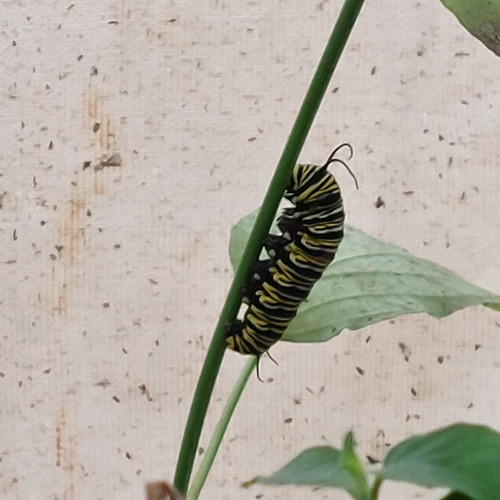
As part of their conservation work on tropical butterflies, the Stratford on Avon Butterfly Farm have a breeding programme. One room showcases this work, and has a few of the caterpillars on their food plants.
The pair of what look like they might be pupae (aka cocoons) were on the underside of one of the leaves of a banana plant in the big hothouse room.