
A few of the several bracket fungi which looked not long emerged on the trunk of one of the trees by the side of a quiet residential road. I’ve no idea which species they are.
A few of the several bracket fungi which looked not long emerged on the trunk of one of the trees by the side of a quiet residential road. I’ve no idea which species they are.

Another patch of shaggy inkcaps I came across some days after the ones in the previous post. These have pretty much got rid of all their spores, Only traces of yhr black mush (there’s probably some technical mycological term) is left at the tops of the stems.
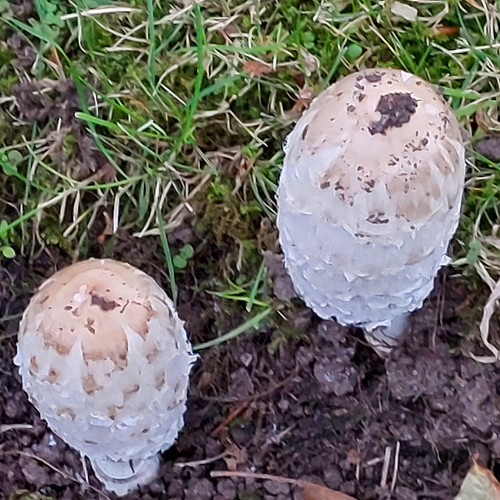
Shaggy inkcaps, also called lawyers wigs. Although I saw these only recently, they are another species which can emerge in any but the cold months of the year. As they release their spores, the caps deliquesce, turning to a black mush heading for the centre.
These look like they were freshly emerged the night before I spotted them.

Some autumn fungi are easy to spot: big enough and bright enough to stand out from undergrowth. Small oysterlings live up to the first part of their name, less than a centimetre high. So they barely stand out from the clumps of moss which seem to be their usual substrate. They aren’t very vivid either.
These were growing on moss on the top of a stone wall, at a convenient height for macro shots on a mobile. They were at a spot where these tiny mushrooms have reappeared every year since I first noticed them.

More from this season’s developing fungi flush. Glistening ink caps are quite common except in the coldest months of the year. They grow in clusters, often larger and closer together than these.
These three groups were neighbours in grass at the edge of a pavement. Probably they emerged on consecutive days, so they show the effects of aging on this species.

Boletes on a front lawn. Boletes are a group of mushroom species where the spores come out of pores on the underside of the cap, not gills.