
Another try at capturing the unusual berry colour of one of the purple beautyberries in West Park. This time I ignored the macro function on my phone’s camera.
Another try at capturing the unusual berry colour of one of the purple beautyberries in West Park. This time I ignored the macro function on my phone’s camera.
Nestling in the base of one of the trees by a quiet cul de sac, a cluster of common inkcaps. In my experience, there are other inkcap species which are commoner.


The purple berries of a purple beautyberry bush in West Park. The not quite in focus effect in the close-ups comes from me struggling with the macro setting on my mobile phone’s camera.

Growing at the base of two (and probably more) of the tree trunks in West Park, shaggy scalycap mushrooms. Within the trunk, the mycelia (the not exactly roots of the fungus) will be spreading white rot, which will eventually prove fatal.
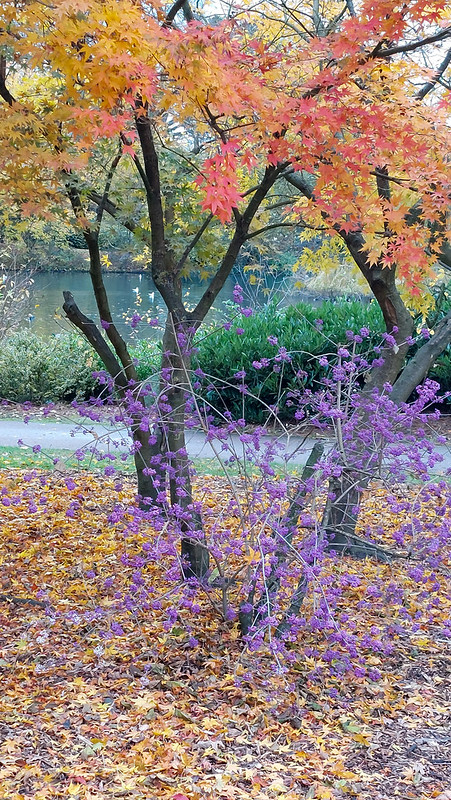
Reds and yellows in the autumn leaves of a Japanese acer overhanging the bright berries of a purple beautyberry bush. Planted in West Park, presumably, for the colour contrast at this time of year. I’m not convinced it works.
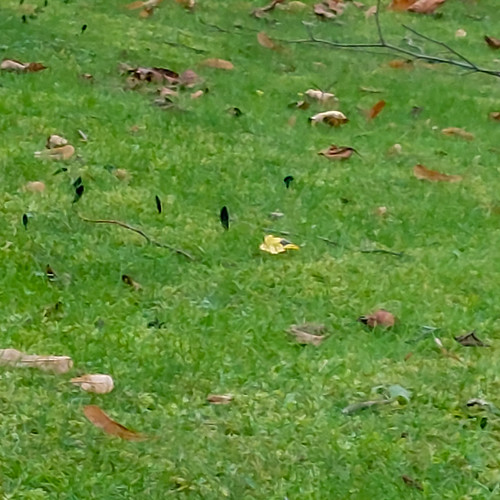
Black club-shaped fungi, growing on a second patch of lawn outside the front of the same flats as the wrinkled club fungi (posted December 2nd). Too far away for a proper inspection.