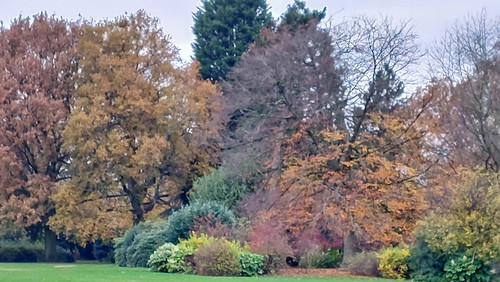
One of West Park’s collection of Japanese acers just beginning its autumn foliage colour change. The acers in the park (trees and bushes) seem to have been carefully chosen for contrasting leaf colours. This one is a lone tree near the edge of the lake.
Autumn fungi: earthstar species
Fungus growing in a front garden: it’s some kind of earthstar, but I’m not sure which species. It isn’t a collared earthstar, which is the type I normally come across.
Gathering for winter: shovellers
West Park lake serves as a refuge for wildfowl which spend the warmer months dispersed elsewhere. The sizes of the goose and swan flocks increase, but most noticeable are the ducks. A handful of tufties usually hang around all year, but in winter the numbers increase perhaps tenfold. Shovellers are off in the spring, and turn up again come autumn.
When I took these shots in mid-October, the birds were just coming out of eclipse, having lost their breeding plumage but not yet completely achieved its winter replacement. Most noticeable in the males.
Autumn fungi: amanitas on a lawn
Amanitas are a group of gilled mushrooms which include the red capped fly agaric. Also in the group are some of the most deadly poisonous fungi (such as the appropriately named death cap) and others highly prized by gourmets.
These were too far away for a proper ID, but I think they were probably either the blusher or the panther, two species which are quite easy to confuse.
Tiny slug on a wet bin
Dustbin day, with bins put out all all along the pavements. Overnight rain had left the bins wet, so one bin had attracted a tiny slug which was crawling slowly over its lid.
Mushrooms growing in the undergrowth below the hedge along a canal footpath. I couldn’t bend down for a closer look to try to get an ID.