
Views of a conifer in Himley Plantation. Its trunk had been snapped in February’s gales.

Views of a conifer in Himley Plantation. Its trunk had been snapped in February’s gales.

Cramp balls are common but often inconspicuous fungi which grow on dead wood. They are also known as King Alfred’s cakes, or as coal fungus.
Cramp balls were used as tinder in traditional fire making, as was the horse’s hoof fungus.

These were on a tree stump by the towpath near Compton Lock.

A variety of rock types on show in one of the lanes off Bridgnorth’s Cartway, connecting the former port area by the river with what was the main town at the top of the cliff.
Below, a short stretch of cobbles exposed in the road. Strictly speaking they are likely to be setts rather than cobbles: quarried and cut into shape rather than being large pebbles rounded by natural action. So they will be granite.
I didn’t examine the stones of the little garden: perhaps a limestone or shale from elsewhere in Shropshire.
The back wall is part of Bridgnorth’s cliff of Permian sandstone. It is rock formed over a quarter of a billion years ago when the earth’s land surfaces had all fused to form one supercontinent, Pangea, and the future Shropshire was somewhere in the middle of a vast sandy desert not far from the tropics. The bedding where one dune overlapped another can be seen in these cliffs – in the picture, most clearly in the rock in bright sunlight on the right.

One cluster of flowers on an elder bush, just as the buds were beginning to open at the end of February.


Cross-bred duck, the parents possibly a mallard and a domesticated duck, swimming on the Sandwell Valley Forge Mill Pool.
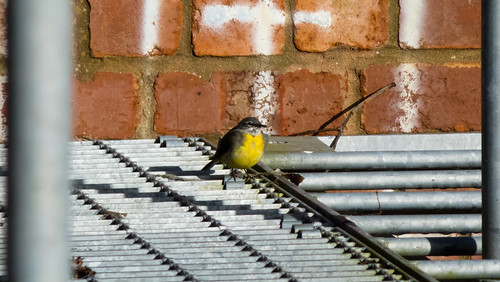
Grey wagtail on the metal grid work at the end of Dunstall Water Bridge, a spot which seems to be a regular haunt of the bird.
This is possibly a female. “Grey” is a misnomer, but the yellow area of the plumage is usually brighter in males, especially now in the breeding season.