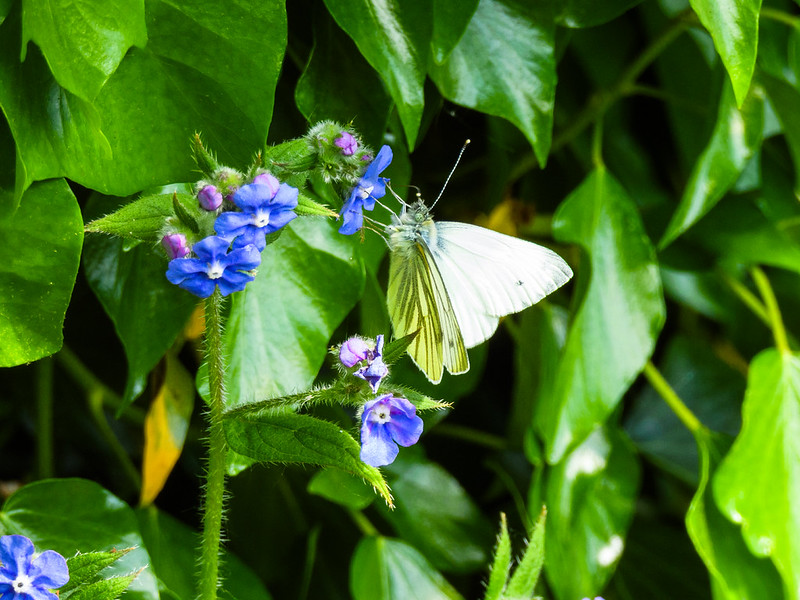
Green-veined white butterfly feeding on blue alkanet flowers

Green-veined white butterfly feeding on blue alkanet flowers

Green veined white butterfly, smallest of the whites and the one that I at least need to see the underwing for a definite ID. This one was systematically going from flower to flower on a patch of blue alkanet, staying long enough on each flower for me to get a shot in.

Eventually, it did give me a glimpse of its underwing. The first picture in this set, but actually the last one I took before someone came along the canal footpath with a dog, and the insect retreated.

Giant dogwood tree, flowering

Giant dogwood tree, flowering

The common dogwood is a native bush, which can be found in woodland as well as gardens. It has bright red wood, and fruit which appears well into the winter.

This is a giant dogwood in someone’s front garden. Its original habitat in in the far end of the Eurasian continent: China, Japan. It’s definitely a tree, which dwarfs the common species. The white leaves are striking; even more so in these pictures, with the flowers a similar colour.

Scarlet tiger caterpillar on the prowl

Scarlet tiger caterpillar on the prowl

A very hungry caterpillar eating away at a blue alkanet. This individual will have hatched some time last summer from one of the eggs laid by a scarlet tiger moth, a brightly coloured day-flying moth.

The caterpillar survived the winter in some safe and snug niche. It re-emerged in April for a final feeding up. It’s now disappeared again to metamorphose, shortly to reappear as one of this year’s adult moths.

Springtime flowers: red horse chestnut

Springtime flowers: red horse chestnut

Some horse chestnuts have red flowers, rather than the usual off-white ones. They’re still arranged in candelabra.

They can sometimes be spotted, like this one, in large domestic gardens. It’s also keeping an eye out for them in parks; there’s a row of three in Bantock Park.

Springtime flowers: horse chestnut candelabra

Springtime flowers: horse chestnut candelabra

The flowers on horse chestnut trees are distinctive in growing in conical formation on stems which rise upward from the twigs of the tree. The elaborate arrangement gets the name candelabra (singular candelabrum).