Categories
David

Wildmoor sandstone, base of Tettenhall ridge

Sandstone

Wildmoor sandstone direcly underlies the Bromsgrove conglomerate featured in a post yesterday. Here are two exposures of the rock heading from the Smestow valley towards Tettenhall ridge.

The first is in one of the many former quarries which are cut into this rock along the Smestow valley. The quarry now forms the site of Sandy Hollow, a small cul de sac off Compton Holloway.

Sandstone

The second is again a quarry face: this time the former quarry now forms the grounds of a house on Old Hill, Tettenhall, just downhill from the Mount public house.

Categories
David

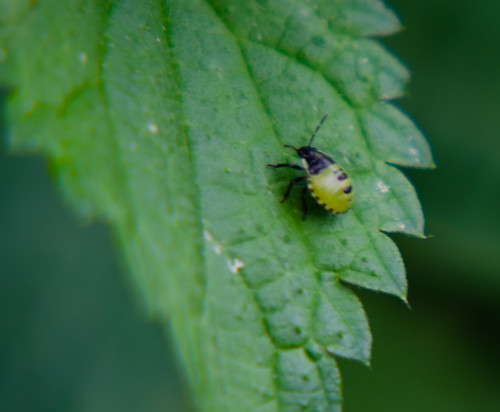
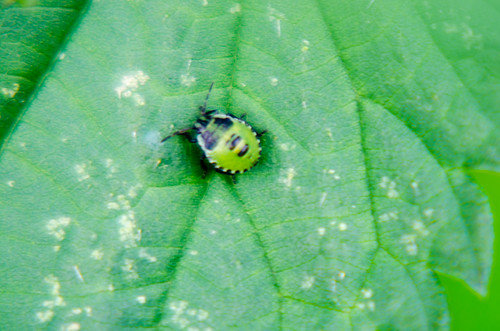
Green insect on a nettle leaf

Green insect on a nettle leaf

This tiny green insect was on a nettle leaf by the canal towpath at Newbridge.

Green insect on a nettle leaf

Categories
David

Mallow flower

Mallow flower

The almose fluorescent colours of a mallow flower in a hedgerow.

Categories
David

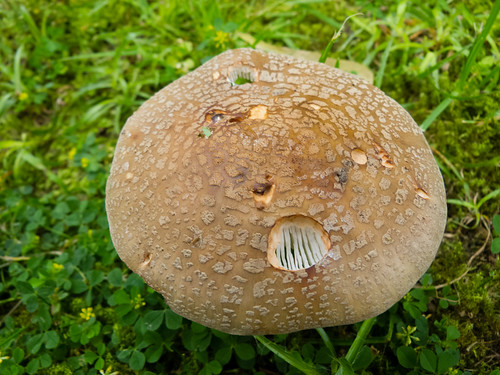
The blusher, a view from above

The blusher

Some kind of very neat eater had been at this mushroom, taking the top off the cap and exposing the gills from above.

Categories
David

Bromsgrove formation exposure, Wobaston Road

Moss and lichen on Bromsgrove formation exposure, Wobaston Road

The Bromsgrove formation is one of the harder rocks which Wolverhampton rests on. The rock, which the more mature of us might know by its former name of Keuper sandstone, forms some of the highest ground in the city: the Tettenhall ridge and Bushbury, then extending from these towards Fordhouses.

Very little of this rock is actually exposed and visible within Wolverhampton’s boundaries (probably the biggest exposure is the Pendeford Rockin’). A little further north, on the road which connects Fordhouses and Pendeford to Bilbrook, there is a high point with a long exposure, probably where a cutting was made to smooth the gradient of the road.

Bromsgrove formation exposure, Wobaston Road

The top picture is a close-up showing some of the mosses and lichens which have colonised the rock face.  By chance, it happens to have missed the larger pebbles which are among the material which was composited to make the rock.

The second picture is taken from  across the road, showing how the entire exposure is well on the way to becoming overgrown.

The dull brownish colour of the rock is very different to the bright sandy red of the immediately underlying rock, the Wildmoor formation (old name: Bunter sandstone) which can be seen in the valley of the Smestow, lower on the Tettenhall ridge or on Finchfield hill.

Categories
David

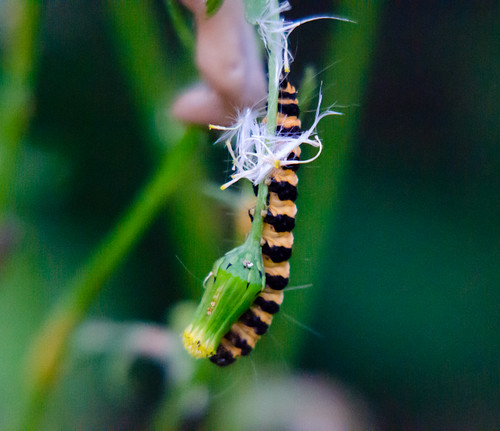
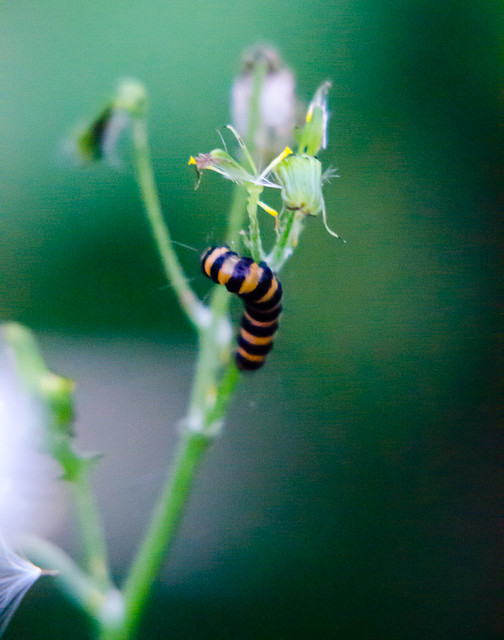
Cinnabar moth caterpillars feeding on ragwort

Cinnabar moth caterpillar feeding on ragwort

The adult of the cinnabar moth is day flying, and brightly coloured to show that it is unpalatable. The yellow and black stripes of the caterpillar serve the same purpose – young caterpillars are just yellow.

Cinnabar moth caterpillar feeding on ragwort

There were several caterpillars on this ragwort: their preferred food source.

Cinnabar moth caterpillar feeding on ragwort

The camera noise in these pictures is because I went out one night at sunset in search of badgers. I didn’t see any, so took this series instead.